Hildegard of Bingen
MedievalMystic
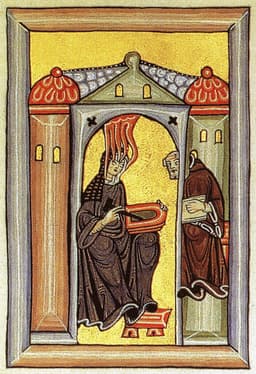
Mystic, composer, herbalist, abbess. She saw visions of living light and wrote them down in books that no man dared suppress.
Hildegard was given to the church at eight years old. She experienced visions from childhood but kept them secret until her forties, when a voice commanded her to write. The result was Scivias, a visionary cosmology unlike anything in the medieval tradition. She composed seventy-seven liturgical songs, wrote on medicine and natural history, founded two monasteries, and corresponded with popes, emperors, and Bernard of Clairvaux. She is the first composer whose biography is known. She described the universe as a cosmic egg animated by divine love.
Places
Ideas
Words
“The soul is a breath of living spirit, that with excellent sensitivity, permeates the entire body to give it life.”
Works
Life & Moments
Born
Born the tenth child of a noble family in the Rhineland. Given to the church as a tithe at age eight, she was enclosed with the anchoress Jutta at the Benedictine monastery of Disibodenberg.
Visions and Writing at Rupertsberg
At forty-two, Hildegard began recording the visions she had experienced since childhood. She wrote Scivias, a vast theological and cosmological work, and founded her own convent at Rupertsberg. She corresponded with popes, emperors, and bishops. Few medieval women had such authority.
Composes Music and Natural Philosophy
Hildegard composed over seventy liturgical songs and a morality play, the Ordo Virtutum. She also wrote on natural history, medicine, and the properties of plants and stones. Her range was extraordinary: visionary, composer, healer, abbess, and philosopher in a world that offered women almost none of these roles.