Pascal
Early Modern
Mathematical genius turned anguished believer. The heart has reasons, he wrote, that reason does not know.
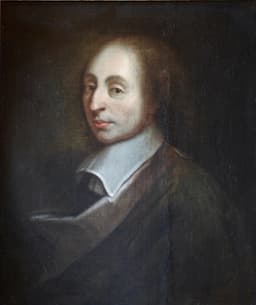
Pascal invented a calculating machine as a teenager, helped found probability theory, and established the physics of the vacuum, then turned from science to the condition of the soul. His Pensees, fragments left at his early death, stare without flinching at human smallness against the silence of infinite space, and at the restlessness no distraction can cure. Faith, he held, is not the conclusion of an argument but a wager the whole person makes, and the heart has reasons reason cannot reach. He is the rare thinker equally at home with a theorem and with dread.
Places
Ideas
Words
“The heart has its reasons, of which reason knows nothing.”
Works
Life & Moments
Born in Clermont
Born in the Auvergne, a prodigy who proved theorems and built a calculating machine as a youth.
The Night of Fire
A two-hour mystical experience he recorded on a paper sewn into his coat, after which he turned from science toward faith.
Influence
Influenced by
- Montaigne
Pascal wrestled with Montaigne, borrowing the force of his skepticism while recoiling from its worldly calm.