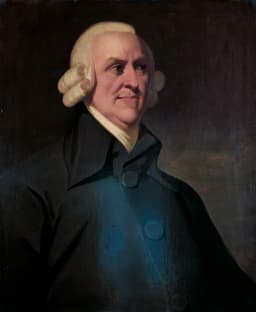
Adam Smith
EnlightenmentScottish
He explained how a market economy works, but he started from a question about why we feel for strangers. His two books are one argument.
Smith was born in Kirkcaldy, Scotland, in 1723 and nearly abducted by gypsies as a child, which he later said would have made a poor philosopher of him. He studied at Glasgow and Oxford, where he found the professors doing nothing and getting paid well for it, an observation that sharpened his later thinking on incentives. He became professor of moral philosophy at Glasgow, where he lectured on ethics, jurisprudence, and economics as parts of a single subject. The Theory of Moral Sentiments appeared in 1759 and made him famous. The Wealth of Nations, published on the same day as the American Declaration of Independence in 1776, made him immortal. He spent his last years as a customs officer in Edinburgh and burned sixteen volumes of manuscript on his deathbed.
Places
Ideas
Words
“It is not from the benevolence of the butcher, the brewer, or the baker that we expect our dinner, but from their regard to their own interest.”
“How selfish soever man may be supposed, there are evidently some principles in his nature which interest him in the fortune of others, and render their happiness necessary to him.”
“Man is an animal that makes bargains: no other animal does this, no dog exchanges bones with another.”
Works
An Inquiry into the Nature and Causes of the Wealth of Nations
·
Published in 1776. The founding text of modern economics. Smith explains how the division of labor, free markets, and the self-interest of individuals combine to create prosperity without anyone intending it.
The Theory of Moral Sentiments
·
Published in 1759, the book Smith himself considered his greatest work. It grounds moral judgment in sympathy and the figure of the impartial spectator: not what I want, but what a fully informed, impartial observer would approve.
Influence
Influenced by
- David Hume
Hume and Smith were the closest of the Scottish Enlightenment thinkers. Smith's moral sentiments theory builds directly on Hume's account of sympathy.