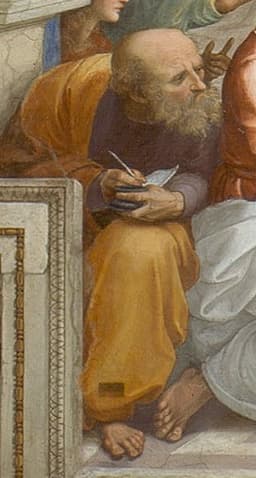
Anaximander
Pre-SocraticMilesian
Thales asked what the world is made of. Anaximander answered: nothing you can name. The origin is the boundless.
A younger associate of Thales, Anaximander refused to ground the world in any single element. Water, air, fire are all limited, and what limits cannot be the source of everything. So he proposed the apeiron, the boundless, an indefinite stuff from which all opposites separate out and into which they return. He drew the first map of the known world, built a sundial, and argued that the earth floats unsupported at the center of things, held by nothing because it has no reason to fall one way rather than another. He even guessed that humans must have descended from other animals, since a human infant could never have survived alone.
Places
Ideas
Words
“From what things existing things come to be, into these they pass away according to necessity; for they pay the penalty to one another for their injustice according to the ordering of time.”
Works
Life & Moments
Born in Miletus
Born in the Ionian city of Miletus, a younger associate of Thales in the first circle of philosophers.
The First Map of the World
Drew the first known map of the inhabited world and a model of the heavens, treating the cosmos as something that could be charted and reasoned about.
Influence
Influenced by
- Thales
Anaximander was the associate and successor of Thales at Miletus, and carried his question about the origin of things in a bolder direction.
Influenced
- Anaximenes
Anaximenes was the pupil of Anaximander and the third of the Milesian thinkers.
