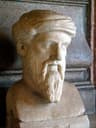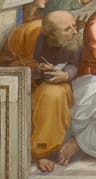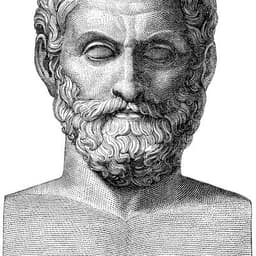
Thales
Pre-SocraticMilesian
The first philosopher. He looked at the world and asked what it was made of.
Before Thales, people explained floods with gods and eclipses with fate. Thales asked a different kind of question: what if the world has a nature, and that nature can be understood? He proposed water as the origin of all things, not as mythology, but as a theory. That shift, from story to inquiry, is where philosophy begins.
Places
Ideas
Words
“Water is the first principle of all things.”
“Know thyself.”
Works
Fragments & Testimonies
fragmentary·
Thales wrote nothing that survives. What we know comes from later authors (Aristotle, Diogenes Laertius, and others) who preserved fragments of his thought on water, the soul, and the divine.
On the Eclipse and Other Predictions
attributed·
Thales is said to have predicted the solar eclipse of 585 BCE and to have measured the height of the pyramids by their shadows. These accounts, preserved by Herodotus and others, made him the first figure where science meets philosophy.
Influence
Influenced
- Pythagoras
Thales may have encouraged the young Pythagoras to travel to Egypt. The Milesian tradition of natural inquiry set the stage for Pythagoras’ mathematical cosmology.
- Anaximander
Anaximander was the associate and successor of Thales at Miletus, and carried his question about the origin of things in a bolder direction.