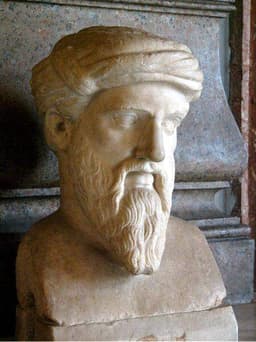
Pythagoras
Pre-SocraticPythagorean
Number is the language of the cosmos. He built a life around that belief.
Pythagoras saw mathematics not as a tool but as truth itself. The harmony of a lyre string, the orbit of the stars, the structure of the soul; all governed by number. He left Samos for Croton, where he founded a community that was part school, part religion, part political movement. His legacy is split between the theorem that bears his name and the mystical idea that understanding the world means hearing its music.
Places
Ideas
Works
The Golden Verses
attributed·
A collection of moral precepts attributed to Pythagoras, though likely composed by later followers. The verses outline a daily practice of self-examination, moderation, and reverence for the cosmic order.
The Life & Doctrines
attributed·
Pythagoras founded a religious community as much as a school. Later sources (Iamblichus, Porphyry, Diogenes Laertius) preserved his teachings on number, music, the transmigration of souls, and the rules of the Pythagorean way of life.
Life & Moments
Born on Samos
Born on the island of Samos, a wealthy trading center known for its engineering achievements. Tradition says he traveled to Egypt and Babylon before returning to begin his philosophical career.
Community at Croton
Pythagoras established a community in Croton that combined philosophical inquiry with religious practice. Members followed strict rules: shared property, vegetarianism, and silence for the first years of study.
Influence
Influenced by
- Thales
Thales may have encouraged the young Pythagoras to travel to Egypt. The Milesian tradition of natural inquiry set the stage for Pythagoras’ mathematical cosmology.
