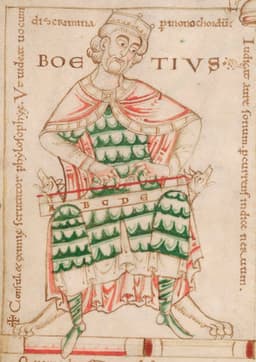
Boethius
MedievalPatristic
The last Roman philosopher. He translated Aristotle, served as consul, and wrote his masterwork in a prison cell while waiting to be executed.
Boethius was born into one of Rome's oldest families. He served as consul under the Ostrogothic king Theodoric, translating Greek philosophy into Latin with the aim of preserving all of Plato and Aristotle for the Latin world. Accused of treason on fabricated charges, he was imprisoned in Pavia. In his cell he wrote The Consolation of Philosophy, a dialogue between himself and Lady Philosophy about fate, fortune, happiness, and the nature of God. It was the most widely read philosophical text of the Middle Ages after the Bible. He was executed in 524.
Places
Ideas
Words
“Nothing is miserable unless you think it so; and on the other hand, nothing brings happiness unless you are content with it.”
Works
Life & Moments
Consul of Rome
Appointed consul under the Ostrogothic king Theodoric. Boethius was the last great Roman to hold the office in any meaningful sense. He translated Aristotle's logic into Latin and dreamed of translating all of Plato and Aristotle. He never got the chance.
Imprisoned by Theodoric
Accused of treason and conspiracy, almost certainly on false charges. Boethius was stripped of his titles and thrown into prison at Pavia. He had gone from the most powerful Roman intellectual to a condemned man waiting to die.
Writes The Consolation of Philosophy
In his cell, waiting for execution, Boethius wrote a dialogue between himself and Lady Philosophy. She visits him in prison and argues that fortune is fickle, virtue is its own reward, and the mind remains free even when the body is chained. The book became one of the most read works in medieval Europe.
Executed
Boethius was beaten and then killed, probably by strangulation. The manner of his death was brutal. The philosopher who had spent his life translating Greek reason into Latin died at the hands of a barbarian king who had once been his patron.
Influence
Influenced by
- Porphyry
Boethius translated and commented on Porphyry's Isagoge, handing the problem of universals to the medieval West.