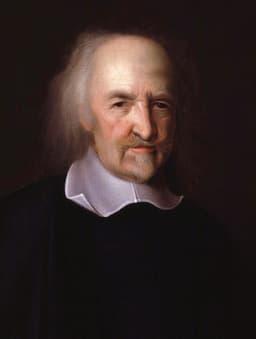
Thomas Hobbes
Early ModernMaterialist
Without government, life is solitary, poor, nasty, brutish, and short. He built political philosophy on fear.
Hobbes was born prematurely when his mother heard the Spanish Armada was coming. Fear, he later said, was his twin. He traveled Europe as a tutor, met Galileo in Florence, and fled to Paris during the English Civil War. There he wrote Leviathan, arguing that humans in a state of nature are in constant war, and that only an absolute sovereign can keep the peace. The book offended royalists and republicans alike. He returned to England after the Restoration and spent his old age translating Homer. He died at ninety-one.
Places
Ideas
Words
“The life of man, solitary, poor, nasty, brutish, and short.”
“Words are the counters of wise men, and the money of fools.”
Works
Life & Moments
Born in Westport, Wiltshire
Born prematurely when his mother heard rumors that the Spanish Armada was approaching. 'My mother gave birth to twins: myself and fear,' he later wrote. His father, a vicar, disappeared after a brawl outside his church.
Flees to Paris
As the English Civil War broke out, Hobbes fled to Paris, fearing for his safety. He spent eleven years in exile there, tutoring the future Charles II and working out his political philosophy. It was the most productive period of his life.
Publishes Leviathan
Published in London, Leviathan argued that without a strong sovereign, human life would collapse into a war of all against all. The book angered royalists and republicans alike. Even in Paris, Hobbes was no longer welcome.
Influence
Influenced by
- Galileo Galilei
Hobbes visited the aging Galileo and modeled his philosophy of bodies in motion on the new mechanical physics.
Influenced
- John Locke
Locke's political philosophy was partly a response to Hobbes: both grounded government in consent, but Locke insisted on natural rights.