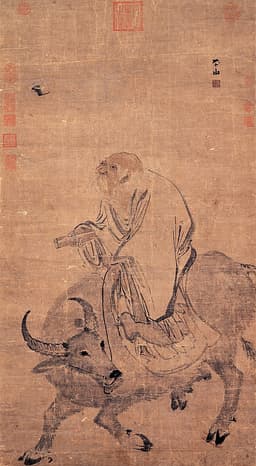
Laozi
ChineseDaoist
The way that can be told is not the real way. He wrote one short book and vanished westward on an ox.
Tradition says Laozi was an archivist at the Zhou court who grew disgusted with the world's decline. On his way into exile, a border guard asked him to write down his wisdom before he left. The result was the Dao De Jing, eighty-one short chapters on the nature of the Way and its power. Whether Laozi was one person, several, or a legend, the text itself transformed Chinese thought. It teaches that the Way cannot be named, that softness overcomes hardness, that the sage leads by doing nothing, and that the universe unfolds of itself when you stop forcing it.
Places
Ideas
Words
“The way that can be told is not the real way.”
“A journey of a thousand miles begins with a single step.”
“Water is the softest thing, yet it can penetrate mountains and earth.”
Works
Life & Moments
Traditional Birth in Chu
Traditional accounts place his birth in the state of Chu. Some sources say he served as an archivist in the Zhou court. Whether he was one man, several, or none at all remains open.
Writing the Dao De Jing
Legend says a border guard asked the old master to write down his teachings before leaving civilization. The result was eighty-one short chapters on the Way and its power. The text may have been compiled over centuries by many hands.
Departure Westward
The story goes that Laozi rode an ox through the western pass and vanished. No one knows where he went. The image stuck: the sage who finished his work and simply left.
