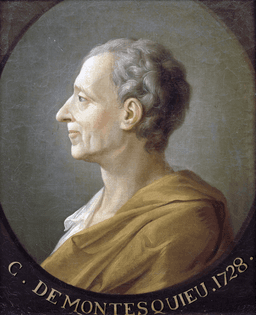
Montesquieu
EnlightenmentFrench
He studied laws the way others studied nature, and gave the modern world the separation of powers.
Montesquieu treated law as a natural phenomenon, shaped by climate, custom, economy, and history, and set out to understand it rather than merely to praise or condemn. The Spirit of the Laws compares governments across the world and across time, and argues that liberty survives only where power is divided against itself, the legislative, executive, and judicial each checking the others. The framers of the American constitution read him closely. He began, slyly, with the Persian Letters, letting fictional travelers from Isfahan expose the absurdities of Paris with an outsider's innocent eye.
Places
Ideas
Words
“Constant experience shows us that every man invested with power is apt to abuse it.”
Works
Life & Moments
Born near Bordeaux
Born to a noble family near Bordeaux, where he later served as a magistrate.
The Spirit of the Laws
Published his comparative study of governments, arguing that liberty survives only where power is divided against itself.
Influence
Influenced by
- John Locke
Montesquieu drew on Locke's account of liberty in building his theory of the separation of powers.