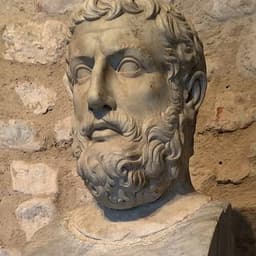
Parmenides
Pre-SocraticEleatic
What is, is. What is not, cannot be thought. Change is an illusion.
Where Heraclitus saw flux, Parmenides saw permanence. In a single philosophical poem, he argued that change, motion, and multiplicity are impossible, that only Being exists, whole and unchanging. The argument sounds absurd, but it forced every thinker after him to account for it. Plato revered him. Aristotle wrestled with him. The problem of Being has never gone away.
Places
Ideas
Words
“What is, is. What is not, cannot be.”
Works
Influence
Influenced
- Plato
Plato named a dialogue after Parmenides and considered him the most formidable of the pre-Socratics. The theory of Forms is partly a response to the Eleatic challenge.
