Plato
ClassicalPlatonist
He saw a world behind the world. The Forms are real; what we see are shadows.
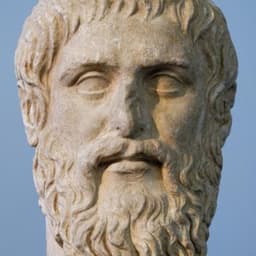
Plato was Socrates’ most devoted student, and after his teacher’s death, he spent years traveling before returning to Athens to found the Academy, the Western world’s first institution of higher learning. His dialogues are philosophy as literature: Socrates arguing about justice, beauty, the good, and the nature of reality itself. His theory of Forms, that the visible world is a reflection of eternal, perfect originals, shaped metaphysics for two millennia.
Places
Ideas
Words
“We can easily forgive a child who is afraid of the dark; the real tragedy of life is when men are afraid of the light.”
“The measure of a man is what he does with power.”
Works
Apology
·
Plato's account of Socrates' defense at his trial. Not an apology in the modern sense but a defiant argument that the examined life is the only life worth living.
Crito
·
Socrates sits in prison, awaiting execution. His old friend Crito arrives before dawn to urge him to escape. Socrates refuses, arguing that one must never do wrong, even in return for wrong done to oneself.
Symposium
·
A dialogue on the nature of love, told through a series of speeches at a drinking party. Socrates recounts the teachings of Diotima on the ascent from physical beauty to the Form of Beauty itself.
Phaedo
·
The dialogue set on the day of Socrates' execution. Contains arguments for the immortality of the soul and the theory of recollection.
Republic
·
Plato's most influential dialogue, exploring justice, the ideal state, the allegory of the cave, and the theory of Forms. It remains the founding text of political philosophy.
Life & Moments
Born in Athens
Born into one of Athens’ most distinguished families. His real name may have been Aristocles; ‘Plato’ was possibly a nickname meaning ‘broad,’ perhaps for his wrestler’s build or the breadth of his style.
Meeting Socrates
Around age twenty, Plato became a student of Socrates. The encounter changed the course of his life. He would later write that before meeting Socrates, he had planned a career in politics.
Death of Socrates
The execution of his teacher was the defining trauma of Plato’s life. He was reportedly too ill to attend the final hours. The event convinced him that Athens’ democracy was fatally flawed and turned him toward philosophy as a vocation.
First Voyage to Syracuse
Plato traveled to Syracuse hoping to influence the tyrant Dionysius I. The visit ended in disaster. Dionysius, angered by Plato’s frank criticism, reportedly had him sold into slavery. Friends ransomed him and he returned to Athens.
Founding of the Academy
After years of travel, Plato returned to Athens and founded the Academy in a grove sacred to the hero Akademos. It became the Western world’s first institution of sustained intellectual inquiry, lasting nearly nine centuries.
Writing the Republic
Plato composed his masterwork, a dialogue on justice, the ideal state, and the nature of reality. The allegory of the cave, the divided line, and the philosopher-king all appear here. It remains the most influential work of political philosophy ever written.
Death in Athens
Plato died in Athens around age eighty, reportedly while attending a wedding feast. He left the Academy to his nephew Speusippus. The school would continue for centuries after his death.
Influence
Influenced by
- Socrates
Plato was Socrates’ most devoted student. After Socrates’ death, Plato made him the central figure of nearly every dialogue he wrote.
- Parmenides
Plato named a dialogue after Parmenides and considered him the most formidable of the pre-Socratics. The theory of Forms is partly a response to the Eleatic challenge.
- Gorgias
Plato made Gorgias the foil of a dialogue, spending a career answering the sophist's claim that persuasion might matter more than truth.
Influenced
- Aristotle
Aristotle studied at Plato’s Academy for twenty years. He revered Plato but fundamentally disagreed with the theory of Forms.
- Cicero
Cicero studied at the Academy in Athens and considered himself an Academic skeptic. His dialogues owe their form to Plato.
- Al-Farabi
Al-Farabi's Virtuous City draws directly on Plato's Republic, adapted for an Islamic context.
- Augustine
Augustine read Plato through the Neoplatonists and built Christian theology on a Platonic foundation.
- Plotinus
Plotinus made Plato vertical, reading the Forms as stages in an emanation descending from the One.
- Philo of Alexandria
Philo read the Torah through Platonic eyes, finding the Forms in Genesis and fusing the God of Moses with Greek reason.