Aristotle
ClassicalPeripatetic
He classified the world. Logic, biology, ethics, politics; he gave each its language.
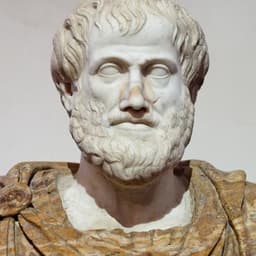
Aristotle studied under Plato for twenty years, then spent a lifetime disagreeing with him. Where Plato looked upward to the Forms, Aristotle looked around: at animals, constitutions, arguments, and stars. He invented formal logic, founded biology as a discipline, and wrote on ethics with a clarity that still holds. He tutored Alexander the Great, founded the Lyceum in Athens, and left behind a body of work that defined the shape of knowledge for centuries.
Places
Ideas
Words
“We are what we repeatedly do. Excellence, then, is not an act, but a habit.”
“Knowing yourself is the beginning of all wisdom.”
“It is the mark of an educated mind to be able to entertain a thought without accepting it.”
Works
Nicomachean Ethics
·
Aristotle's most important work on ethics. Argues that happiness (eudaimonia) is the highest good, achievable through a life of virtue and the cultivation of practical wisdom.
Politics
·
A systematic study of the state, citizenship, and constitutions. Famous for declaring that humans are by nature political animals.
Metaphysics
·
A collection of treatises on first philosophy: the study of being as being, substance, causation, and the unmoved mover.
Poetics
·
The earliest surviving work of dramatic theory. Defines tragedy, introduces catharsis, and argues that poetry is more philosophical than history.
Life & Moments
Born in Stagira
Born to Nicomachus, personal physician to the Macedonian king Amyntas III. Growing up in a medical household may have instilled the empirical, observational temperament that marked all his work.
Joining the Academy
At seventeen, Aristotle traveled to Athens and enrolled in Plato’s Academy. He stayed for twenty years, first as a student, then as a teacher. Plato called him ‘the mind of the school.’
Tutor to Alexander
Philip II of Macedon invited Aristotle to tutor his son Alexander. For several years, the greatest philosopher of the age taught the future conqueror of the known world. What exactly he taught remains one of history’s great mysteries.
Founding of the Lyceum
Aristotle returned to Athens and established the Lyceum, where he taught while walking along the covered walkway (peripatos). His school became known for empirical research, systematic classification, and the sheer range of subjects it investigated.
Exile and Death
After Alexander’s death, anti-Macedonian sentiment swept Athens. Aristotle, with his Macedonian connections, was charged with impiety. He fled, reportedly saying he would not let Athens sin twice against philosophy. He died the following year.
Influence
Influenced by
- Plato
Aristotle studied at Plato’s Academy for twenty years. He revered Plato but fundamentally disagreed with the theory of Forms.
Influenced
- Cicero
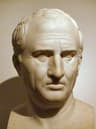
Cicero admired Aristotle's style and drew on his rhetorical and ethical writings throughout his career.
- Al-Kindi
Al-Kindi supervised the translation of Aristotle into Arabic and built on his metaphysics.
- Ibn Rushd
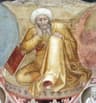
Ibn Rushd wrote three levels of commentary on nearly every work of Aristotle.
- Thomas Aquinas
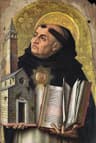
Aquinas called Aristotle simply 'The Philosopher' and built the Summa Theologica on Aristotelian logic and metaphysics.
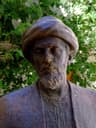
- Maimonides
Maimonides took Aristotle as the measure of reason and labored to reconcile him with the Torah.
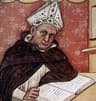
- Albertus Magnus
Albert set himself the task of making the whole of Aristotle available to the Latin world.
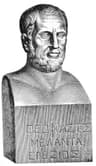
- Theophrastus
Theophrastus succeeded Aristotle as head of the Lyceum and carried his empirical method into botany and the study of character.