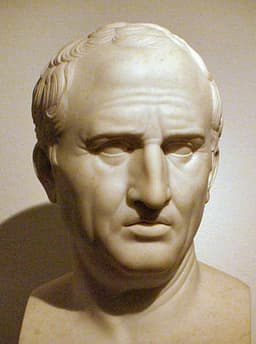
Cicero
RomanEclectic
He translated Greek philosophy into Latin and into politics. Rome's greatest orator was also its most restless thinker.
Cicero studied in Athens and Rhodes, absorbing every Greek school (Stoic, Academic, Epicurean) and carried them back to Rome. He held the highest offices of the Republic, survived conspiracies, and was murdered in the civil wars that followed Caesar. Between political crises he wrote at ferocious speed: dialogues on duty, friendship, old age, the nature of the gods, and the proper ends of life. He never founded a school or claimed originality. What he did was make philosophy speakable in Latin, and through Latin, in every European language that came after.
Places
Ideas
Words
“The life of the dead is placed in the memory of the living.”
“A room without books is like a body without a soul.”
Works
Tusculan Disputations
·
Five books of philosophical dialogue set at Cicero's villa in Tusculum. They tackle the fear of death, the endurance of pain, grief, the passions, and whether virtue alone is sufficient for happiness.
On Duties
·
A treatise on moral obligation addressed to his son Marcus. The most copied philosophical text of the Middle Ages. It asks: when duty and advantage seem to conflict, which should win?
Life & Moments
Born in Arpinum
Born to an equestrian family in the hill town of Arpinum, southeast of Rome. His cognomen means 'chickpea,' a fact he refused to change despite advice from friends who found it undignified.
Studies in Athens and Rhodes
Cicero traveled to Greece to study philosophy and oratory. In Athens he attended lectures at the Academy and met the Epicurean Phaedrus. In Rhodes he studied rhetoric under Molon. The trip shaped the rest of his intellectual life.
Consul of Rome
Elected consul, the highest office in the Republic, as a 'new man' with no noble ancestry. He uncovered and crushed the Catiline conspiracy, a plot to overthrow the state. He called it his finest hour. His enemies would use it against him for decades.
Philosophical Works in Retirement
Pushed out of politics by Caesar's dictatorship, Cicero turned to writing with furious energy. In barely two years he produced On the Nature of the Gods, On Duties, Tusculan Disputations, and more. He translated Greek philosophy into Latin and into common sense.
Killed by Antony's Soldiers
After the assassination of Caesar, Cicero attacked Mark Antony in a series of blistering speeches. Antony placed him on the proscription list. Soldiers caught him fleeing near Formia. He bared his neck to the sword. His hands and head were nailed to the speaker's platform in the Forum.

