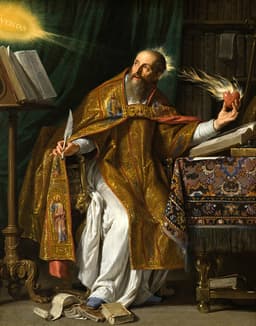
Augustine
MedievalPatristic
He stole pears as a boy and never forgave himself. His restless search for truth took him through every philosophy before it brought him to God.
Augustine was born in North Africa to a Christian mother and a pagan father. He studied rhetoric in Carthage, fell in with the Manichaeans, moved to Milan, and there heard Ambrose preach. At thirty-two, sitting in a garden, he heard a child's voice say 'Take and read.' He opened Paul's letters at random and his life turned. He became Bishop of Hippo and spent the next thirty-five years writing. The Confessions invented autobiography. The City of God reimagined history. His thought on grace, free will, and original sin shaped Western Christianity for a millennium.
Places
Ideas
Words
“You have made us for yourself, O Lord, and our hearts are restless until they rest in you.”
“The world is a book, and those who do not travel read only one page.”
Works
Confessions
·
The first autobiography in Western literature. Augustine traces his journey from theft, lust, and intellectual pride to conversion in a Milan garden. Part memoir, part prayer, part philosophy.
The City of God
·
Written after Rome fell to the Visigoths in 410. Augustine argues that human history is the story of two cities: the earthly city of self-love and the heavenly city of love for God.
Life & Moments
Born in Thagaste
Born in the small North African town of Thagaste to a pagan father and a Christian mother, Monica. He grew up speaking Latin, never learned much Greek, and spent his youth chasing ambition and pleasure in roughly equal measure.
Conversion in Milan
After years of restless searching through Manichaeism and Neoplatonism, Augustine heard a child's voice in a garden saying 'take up and read.' He opened Paul's letter to the Romans and the struggle ended. He was baptized by Ambrose the following Easter.
Becomes Bishop of Hippo
Ordained almost against his will, Augustine became bishop of the port city of Hippo Regius. He would hold the office for thirty-five years, preaching, arbitrating disputes, and writing constantly. The small-town bishop became the most influential theologian in Western Christianity.
Writes the Confessions
Part autobiography, part prayer, part philosophy. Augustine invented a new literary form: the honest examination of one's own inner life. He wrote about stealing pears as a boy, about lust, about weeping at his mother's death. Nothing like it had existed before.
Dies as the Vandals Besiege Hippo
Augustine died at seventy-five while Vandal armies surrounded his city. He asked that the penitential psalms be written on the walls of his room so he could read them from bed. Hippo fell shortly after. His books survived.
Influence
Influenced by
Influenced
- Anselm
Anselm built on Augustine's fusion of faith and reason, developing the ontological argument from Augustinian premises.
- Bonaventure
Bonaventure kept faith with Augustine and the mystical tradition where his contemporaries leaned on Aristotle.