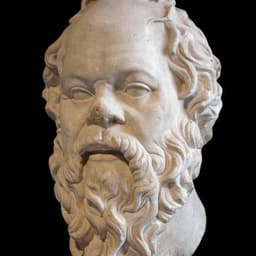
Socrates
ClassicalSocratic
He wrote nothing, but changed everything. Philosophy became a conversation.
Socrates walked barefoot through Athens, asking questions that made powerful people uncomfortable. He claimed to know nothing, which made him wiser than those who claimed to know everything. His method (relentless questioning, following the argument wherever it leads) became the foundation of Western philosophy. Athens executed him for it. He drank the hemlock calmly, still talking about the soul.
Places
Ideas
Words
“The unexamined life is not worth living.”
“I know that I know nothing.”
“To find yourself, think for yourself.”
Works
Apology
Plato··
Plato's account of Socrates' defense at his trial. Not an apology in the modern sense but a defiant argument that the examined life is the only life worth living.
Crito
Plato··
Socrates sits in prison, awaiting execution. His old friend Crito arrives before dawn to urge him to escape. Socrates refuses, arguing that one must never do wrong, even in return for wrong done to oneself.
Phaedo
Plato··
The dialogue set on the day of Socrates' execution. Contains arguments for the immortality of the soul and the theory of recollection.
Life & Moments
Born in Athens
Born to Sophroniscus, a stonemason, and Phaenarete, a midwife. His mother’s profession would later become a metaphor for his own method: helping others give birth to ideas.
Questioning in the Agora
For decades, Socrates walked the streets and marketplaces of Athens, engaging anyone who would talk (politicians, poets, craftsmen) in relentless philosophical conversation. He charged nothing and claimed to teach nothing.
The Oracle’s Declaration
Chaerephon, a friend of Socrates, asked the oracle at Delphi whether anyone was wiser than Socrates. The oracle said no. Socrates spent the rest of his life trying to understand what this meant.
Trial and Conviction
Charged with impiety and corrupting the youth of Athens. Socrates defended himself not by begging for mercy but by arguing that his questioning was a service to the city. The jury convicted him by a narrow margin.
Death by Hemlock
Socrates drank the hemlock calmly, surrounded by friends. His last words, as Plato recorded them, were about a debt owed to the god of healing. He died as he lived: asking questions, following the argument to its end.
Influence
Influenced
- Plato
Plato was Socrates’ most devoted student. After Socrates’ death, Plato made him the central figure of nearly every dialogue he wrote.
- Diogenes
Diogenes radicalized Socratic simplicity. Where Socrates questioned convention through argument, Diogenes demolished it through action.
- Pyrrho
Socrates’ profession of ignorance resonated with the skeptical tradition. Pyrrho pushed the Socratic admission further: if we know nothing, perhaps we should stop claiming to.


