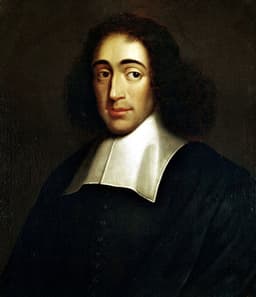
Spinoza
Early ModernRationalist
God and Nature are the same thing. He was excommunicated for saying it, ground lenses to earn a living, and published his masterwork after he died.
Spinoza was born into the Portuguese Jewish community in Amsterdam. At twenty-three he was excommunicated with a curse so severe that no member of the community was allowed to read his writings or stand within four cubits of him. He spent the rest of his life grinding optical lenses and writing philosophy. His Ethics, written in geometric form with definitions, axioms, and proofs, argues that God and Nature are identical, that everything that happens is necessary, and that freedom consists in understanding this necessity. The book was published after his death in 1677. He died of a lung disease at forty-four.
Places
Ideas
Words
“I have made a ceaseless effort not to ridicule, not to bewail, not to scorn human actions, but to understand them.”
Works
Life & Moments
Born in Amsterdam
Born into the Portuguese-Jewish community of Amsterdam. His family had fled the Inquisition in Portugal. He grew up speaking Portuguese, Spanish, Dutch, and Hebrew, and was educated in the Torah and Talmud.
Excommunicated from the Jewish Community
At twenty-three, the Amsterdam synagogue issued a cherem against him, one of the harshest ever recorded. The document cursed him in extraordinary language and forbade all Jews from speaking to him or standing within six feet of him. He never looked back.
Ethics Published Posthumously
His masterwork, the Ethics, was published by friends after his death. Written in the style of geometric proofs, it argued that God and Nature are one substance, that free will is an illusion, and that the highest human good is understanding. He had kept the manuscript hidden during his lifetime.
Influence
Influenced by
- Descartes
Spinoza took Descartes' substance metaphysics and radicalized it: instead of two substances, there is only one.