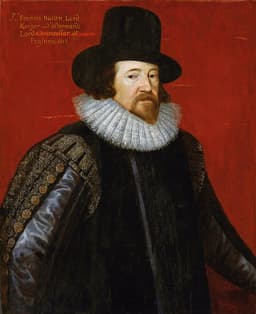
Francis Bacon
Early ModernEmpiricist
Knowledge is power. He tore down the old logic and built a new one based on observation, experiment, and induction.
Bacon served as Lord Chancellor of England and was disgraced for taking bribes. His philosophical legacy outlasted the scandal. His Novum Organum proposed replacing Aristotelian deduction with systematic observation and experiment. He catalogued the 'idols' that distort human thinking: the idols of the tribe (shared biases), the cave (personal biases), the marketplace (language), and the theatre (received systems). He died in 1626 after catching cold while stuffing a chicken with snow to study refrigeration. He was testing his own method.
Places
Ideas
Words
“Knowledge is power.”
“Read not to contradict and confute, nor to believe and take for granted, but to weigh and consider.”
Works
Life & Moments
Born in London
Born at York House in the Strand, the youngest son of Sir Nicholas Bacon, Lord Keeper of the Great Seal. He grew up in the corridors of Elizabethan power and never quite left them.
Writes Novum Organum
Published his Novum Organum, a new logic for investigating nature. He argued that centuries of philosophy had produced little real knowledge because thinkers relied on deduction from untested premises. What was needed, he said, was careful observation, experiment, and induction.
Dies After an Experiment with Snow
While riding through Highgate in winter, he stopped to stuff a chicken with snow to see if cold could preserve meat. He caught a chill and died days later. His last letter noted that the experiment had gone well.
Influence
Influenced
- John Locke
Bacon's emphasis on observation and experiment laid the groundwork for Locke's empiricism.