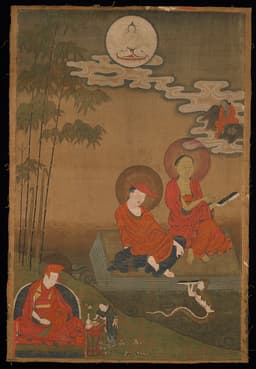
Nagarjuna
IndianBuddhist
Everything is empty. Not empty of existence, but empty of independent, permanent essence. He turned Buddhist logic into a razor.
Nagarjuna was born in South India around 150 CE and became the most important Buddhist philosopher after the Buddha himself. He founded the Madhyamaka (Middle Way) school, which argues that all things are 'empty' of inherent existence. Nothing exists independently; everything arises in dependence on causes and conditions. This is not nihilism. Emptiness is the condition that makes change, growth, and liberation possible. His method was to take any philosophical position and show that it leads to contradiction, leaving only the middle way between extremes.
Places
Ideas
Words
“Whatever is dependently arisen, that is explained to be emptiness.”
“Without a foundation in conventional truth, the significance of the ultimate cannot be taught.”
Works
Life & Moments
Born in South India
Born in the Andhra region of South India, probably into a Brahmin family. The details of his early life are buried under layers of legend. Tibetan sources say he lived for six hundred years, which tells you more about his reputation than his biography.
Founds Madhyamaka Philosophy
Nagarjuna developed the philosophy of the middle way between existence and non-existence. Everything that exists, he argued, does so only in dependence on other things. Nothing has an essence of its own. This is not nihilism but a radical rethinking of what it means for anything to be real.
Writes the Mulamadhyamakakarika
His masterwork, the Fundamental Verses of the Middle Way, consists of roughly 450 verses that systematically dismantle every philosophical position, including his own. The text is dense, often paradoxical, and has generated commentary for nearly two thousand years.
Influence
Influenced by
- The Buddha
Nagarjuna took the Buddha's teaching on dependent origination and built it into a systematic philosophy of emptiness.
Influenced
- Vasubandhu
Vasubandhu's Yogacara took shape alongside the Madhyamaka tradition that Nagarjuna founded, the two great wings of Mahayana thought.
